
- Renewable Generation
- Solar Thermal
- Thermal Storage
- Turnkey EPC
Concentrated Solar Power
Trough | Tower | Fresnel | Dish | Molten Salt | Steam Cycle | Process Heat
Sunlight stored as heat, delivered after sunset.
Concentrated solar power uses mirrors to focus direct sunlight onto a receiver, heats a fluid to several hundred degrees and runs a steam turbine. Because heat is far cheaper to store than electricity, a CSP plant with molten-salt tanks can keep generating for many hours after dark. BARREL provides and coordinates CSP and solar thermal projects from DNI assessment and technology selection through design, approvals, construction and grid connection to long-term operation.
DDNI
Strong direct sunlight, not just bright skies
HHeat
Mirrors concentrate sunlight into high-temperature heat
SStorage
Molten salt shifts output into the evening
- Typical unit size
- 50–150 MW
- Annual DNI sought
- ≥ 1,800 kWh/m²
- Molten-salt storage
- 6–15 h
- Working temperature
- 390–565 °C
- Asset life
- 30+ yrs
Section 01
Concentrated Solar Power — Overview
A CSP plant has three parts: a solar field of mirrors that concentrates sunlight, a receiver and heat-transfer system that turns it into heat, and a power block that turns heat into electricity, usually through a steam turbine.
Unlike photovoltaics, CSP uses only direct-beam sunlight and works best in clear, dry, sunny regions. Its strength is dispatchability: with thermal storage it can supply evening and night demand and support the grid with a synchronous generator.
1.1Why CSP
01
Dispatchable solar
Thermal storage lets the plant generate on demand, including after sunset, at a planned schedule.
02
Low-cost storage
Storing heat in molten salt costs much less per kWh than storing electricity in batteries, for long durations.
03
Grid strength
A steam turbine-generator gives inertia, reactive power and fault current, like a conventional plant.
04
Firming PV
In a hybrid, PV supplies cheap daytime power while CSP storage covers the evening peak and night.
05
Industrial heat
The same collectors can supply steam or hot oil to industries, replacing fuel in boilers.
06
Local content
Steel structures, mirrors, civil works and installation employ local industry and labour.
1.2Energy path in a CSP plant with storage
- Direct sunlight
- Mirror field
- Receiver
- Heat-transfer fluid
- Hot-salt tank
- Steam generator
- Turbine-generator
- Grid
Section 02
CSP Technologies
CSP systems differ in how they focus the sun: along a line (trough and Fresnel) or onto a point (tower and dish). Point-focus systems reach higher temperatures and higher cycle efficiency.
01
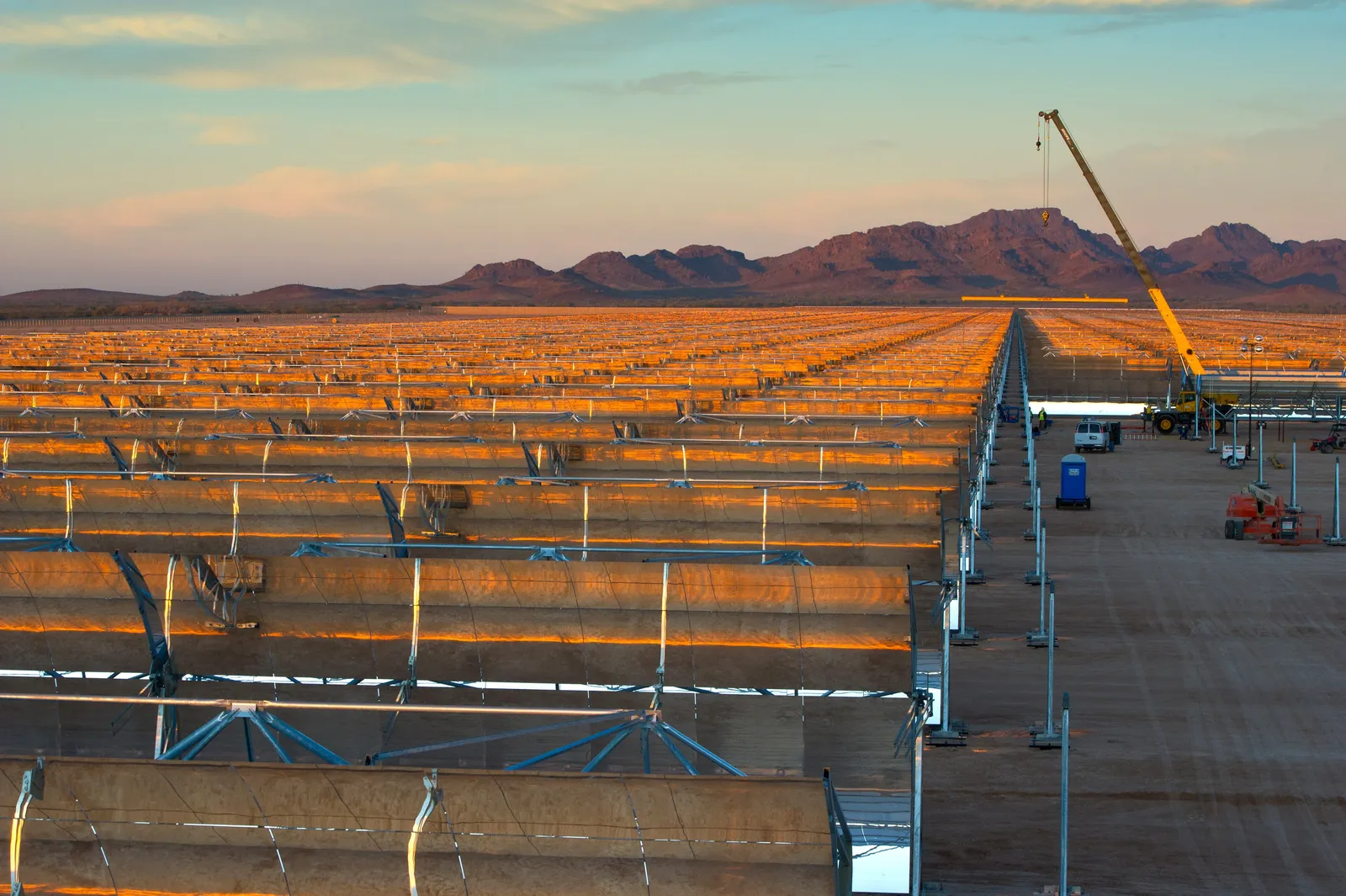
Line focusParabolic trough
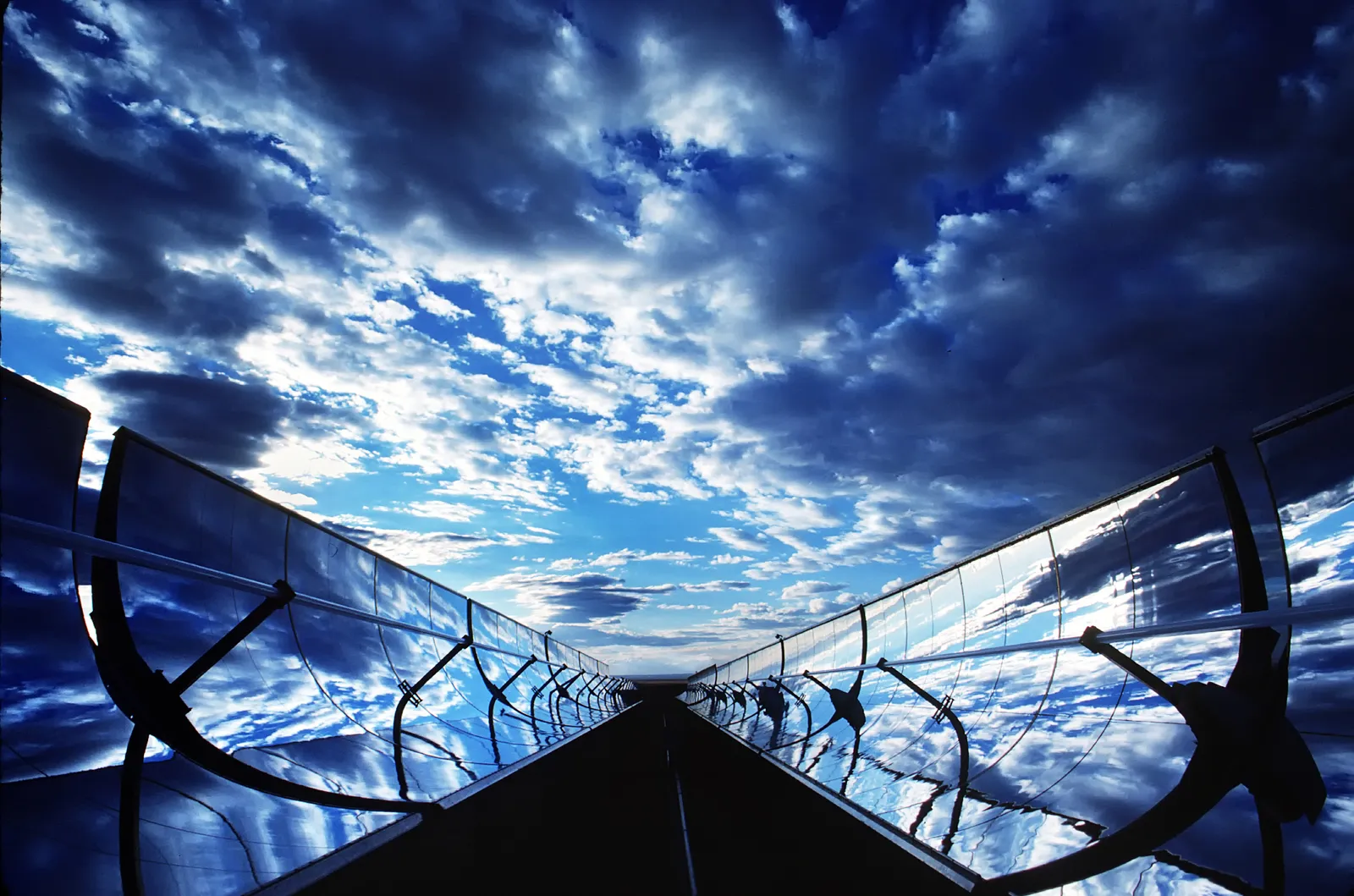
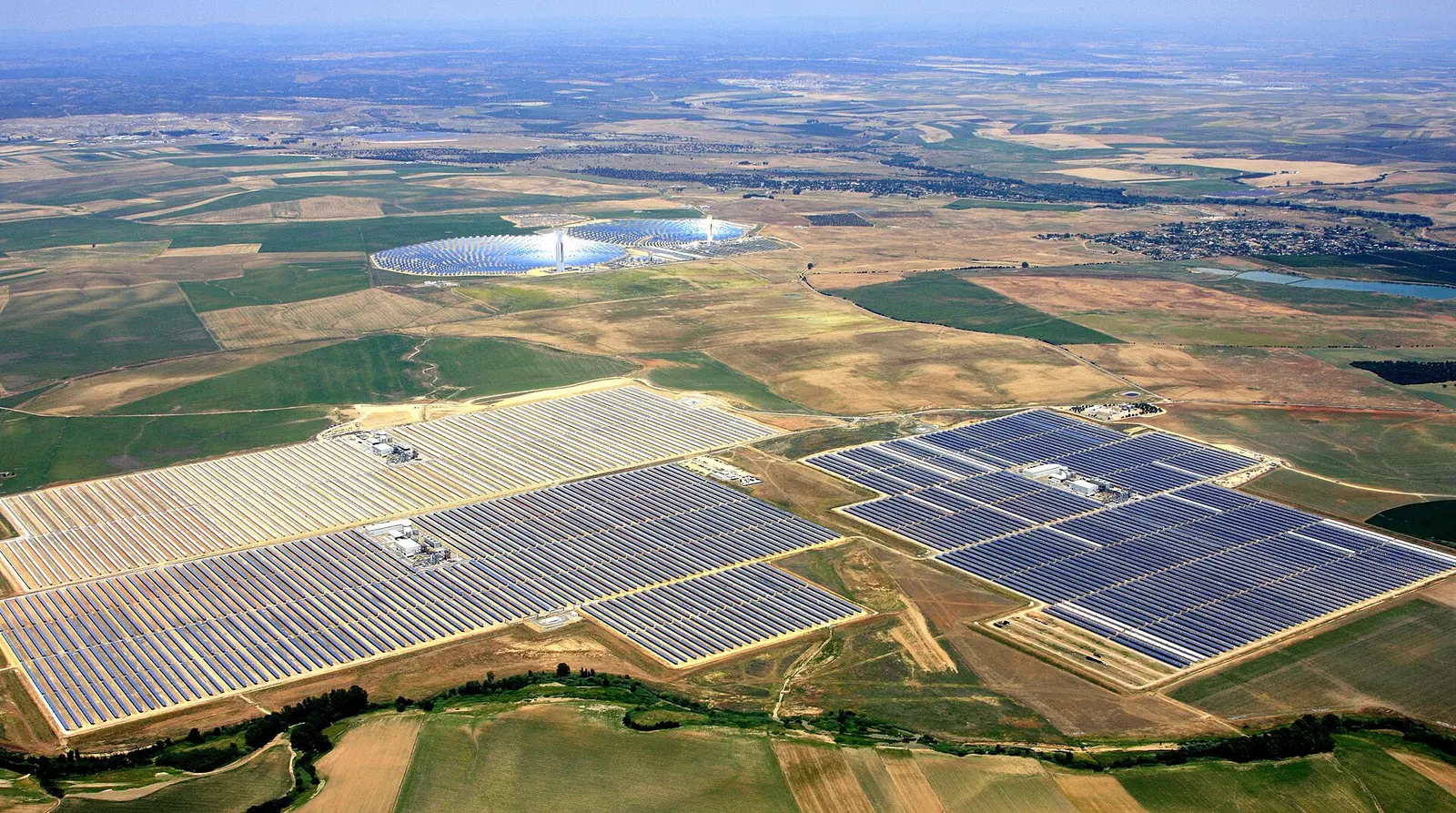
Curved mirrors track the sun on one axis and focus onto an evacuated receiver tube carrying thermal oil or molten salt. The most widely built CSP technology.
02
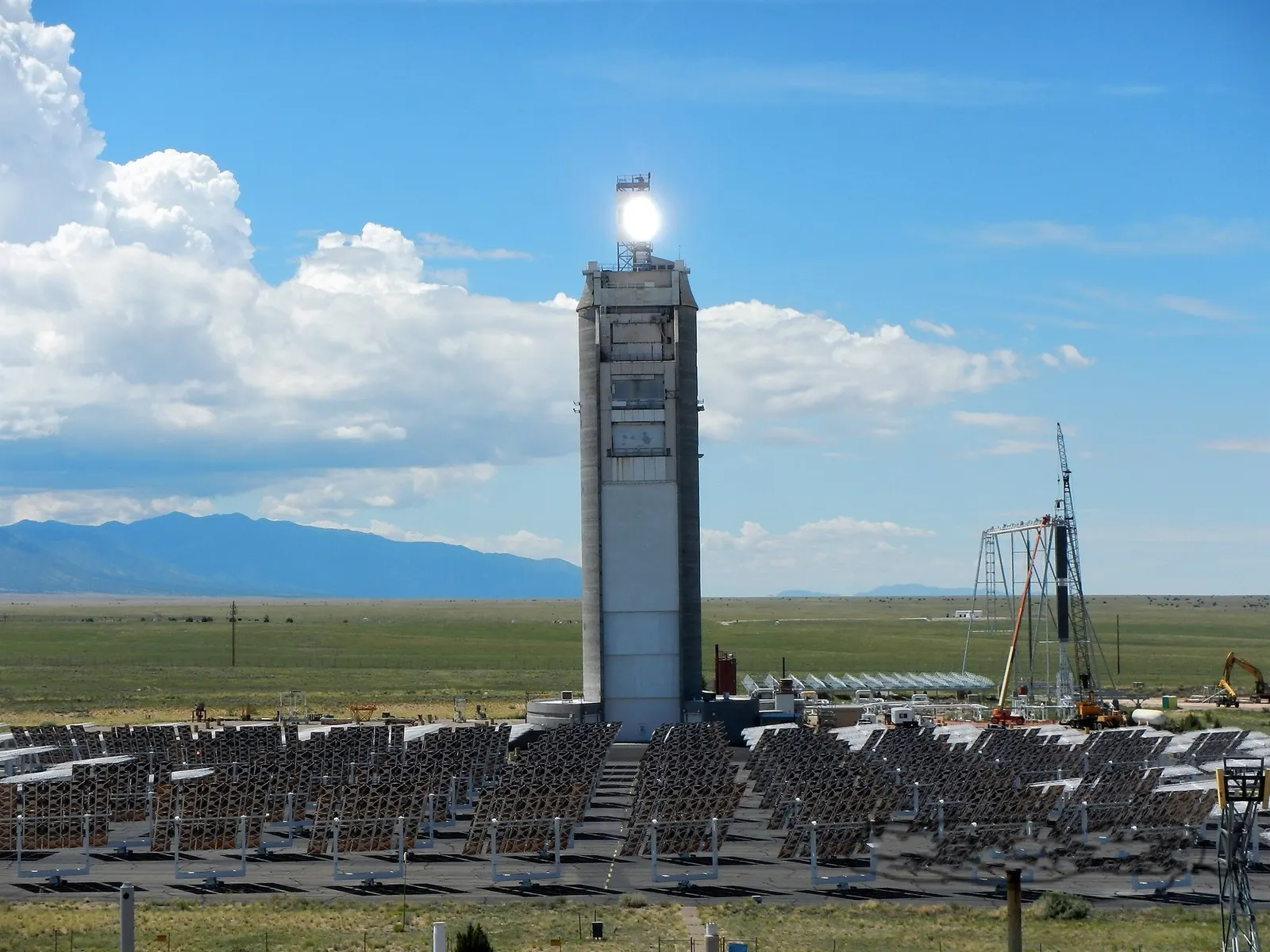
Point focusSolar tower (central receiver)
Thousands of flat, two-axis tracking heliostats reflect sunlight onto a receiver on top of a tower, heating molten salt to about 565 °C.
03
Line focusLinear Fresnel
Long, nearly flat mirror strips focus onto a fixed receiver above them; simpler and cheaper but less efficient; often used for steam and process heat.
04
Point focusParabolic dish
A dish concentrates sunlight onto a receiver at its focus, often driving a Stirling engine; modular but rarely built at utility scale.
2.1Technology comparison (indicative)
| Technology | Concentration ratio | Fluid temperature | Storage fit | Maturity |
|---|---|---|---|---|
| Parabolic trough (oil) | 70–100× | Up to about 390 °C | Indirect two-tank salt | Most commercial experience |
| Solar tower (salt) | 500–1,000× | About 290–565 °C | Direct two-tank salt | Commercial, growing share |
| Linear Fresnel | 25–100× | 250–450 °C | Limited; steam accumulators | Commercial, smaller plants |
| Parabolic dish | Up to about 2,000× | Above 700 °C | Little | Demonstration and niche |
Section 03
Solar Resource and Site Assessment
CSP depends on direct normal irradiance (DNI): the beam sunlight arriving straight from the sun's disc. Haze, dust and cloud scatter it, so a site that suits PV may not suit CSP.
Satellite data gives a first view, but bankable projects need at least a year of on-site ground measurement correlated with long-term satellite records.
3.1Solar-to-electric efficiency
Overall conversion chain
ηsolar→el = ηoptical × ηreceiver × ηstorage × ηcycle × (1 − fparasitic)
Annual energy E ≈ DNI × Aaperture × ηsolar→el (annual average); indicative annual ηsolar→el 13–18 % for trough, 15–20 % for tower
Each stage loses some energy: mirrors reflect and track imperfectly, the receiver loses heat, the steam cycle is limited by its temperature, and pumps, tracking and cooling consume part of the output.
| Symbol | Meaning |
|---|---|
| ηoptical | Mirror reflectivity, cleanliness, cosine and shading losses (about 0.55–0.75 annual) |
| ηreceiver | Share of focused energy kept as heat (about 0.85–0.92) |
| ηstorage | Heat kept through the storage tanks (about 0.98–0.99) |
| ηcycle | Steam cycle gross efficiency (about 0.37–0.43) |
| fparasitic | Fraction of output used by the plant itself (about 0.08–0.12) |
| Aaperture | Total mirror aperture area, m² |
3.2Site studies
Resource
5- Ground DNI, GHI and DHI measurement station
- Long-term satellite correlation (P50 / P90)
- Dust, soiling rate and aerosol study
- Wind speed for mirror stow and structure design
- Ambient temperature for cooling design
Land and utilities
5- Flat land, slope ideally below 1–3 %
- About 2–3 ha per MW for trough with storage (higher for towers)
- Water for cleaning and cooling, or dry cooling
- Grid substation within reasonable distance
- Geotechnical survey for tower and tank foundations
In India, the best DNI is found in parts of Rajasthan, Gujarat and Ladakh; seasonal monsoon cloud and dust reduce annual DNI compared with desert regions of North Africa, the Middle East, Chile and Australia.
Section 04
Molten-Salt Thermal Energy Storage
Most modern CSP plants store heat in a mixture of sodium and potassium nitrate ("solar salt") held in two large insulated tanks: a cold tank at about 290 °C and a hot tank at up to 565 °C.
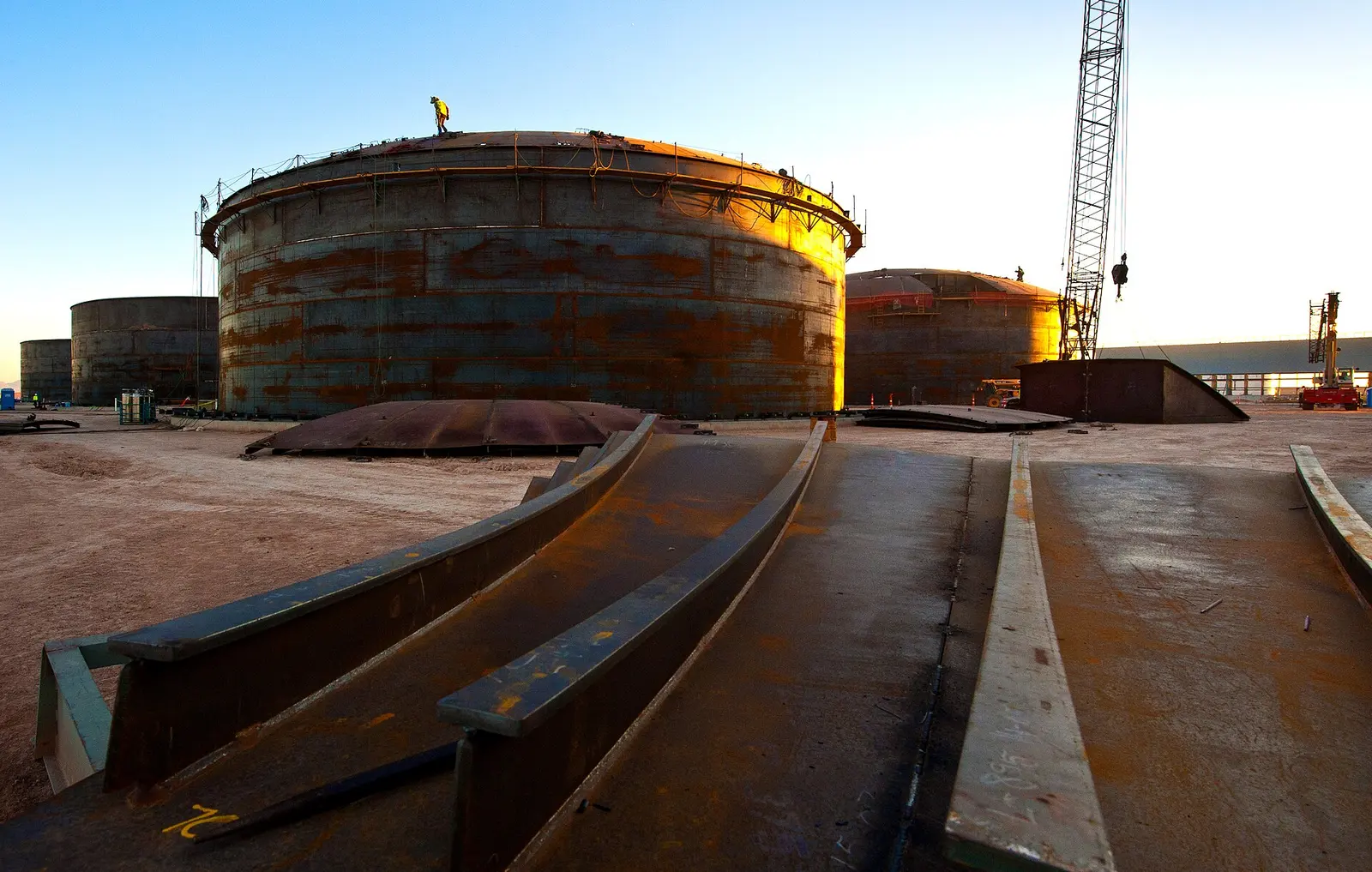
4.1How two-tank storage works
- 1Cold salt is pumped from the cold tank to the receiver (direct) or to an oil-to-salt heat exchanger (indirect)
- 2Heated salt flows into the hot tank during sunny hours
- 3When power is needed, hot salt is pumped through the steam generator
- 4Cooled salt returns to the cold tank, ready to be heated again
- 5Heat tracing and minimum tank levels keep salt above its freezing point of about 220–240 °C
4.2Sizing terms
| Term | Meaning | Typical value (indicative) |
|---|---|---|
| Storage hours | Hours of full turbine output from a full hot tank | 6–15 h |
| Solar multiple | Solar field thermal output at design ÷ power block thermal input | 2–3 with long storage |
| Salt inventory | Mass of salt in the system | Tens of thousands of tonnes for a large plant |
| Round-trip thermal efficiency | Heat recovered ÷ heat stored | About 98–99 % |
Section 05
Solar Field and Power Block Equipment
The solar field is the largest cost item; the power block is a conventional Rankine steam cycle adapted to daily starts and variable heat input.
Solar field
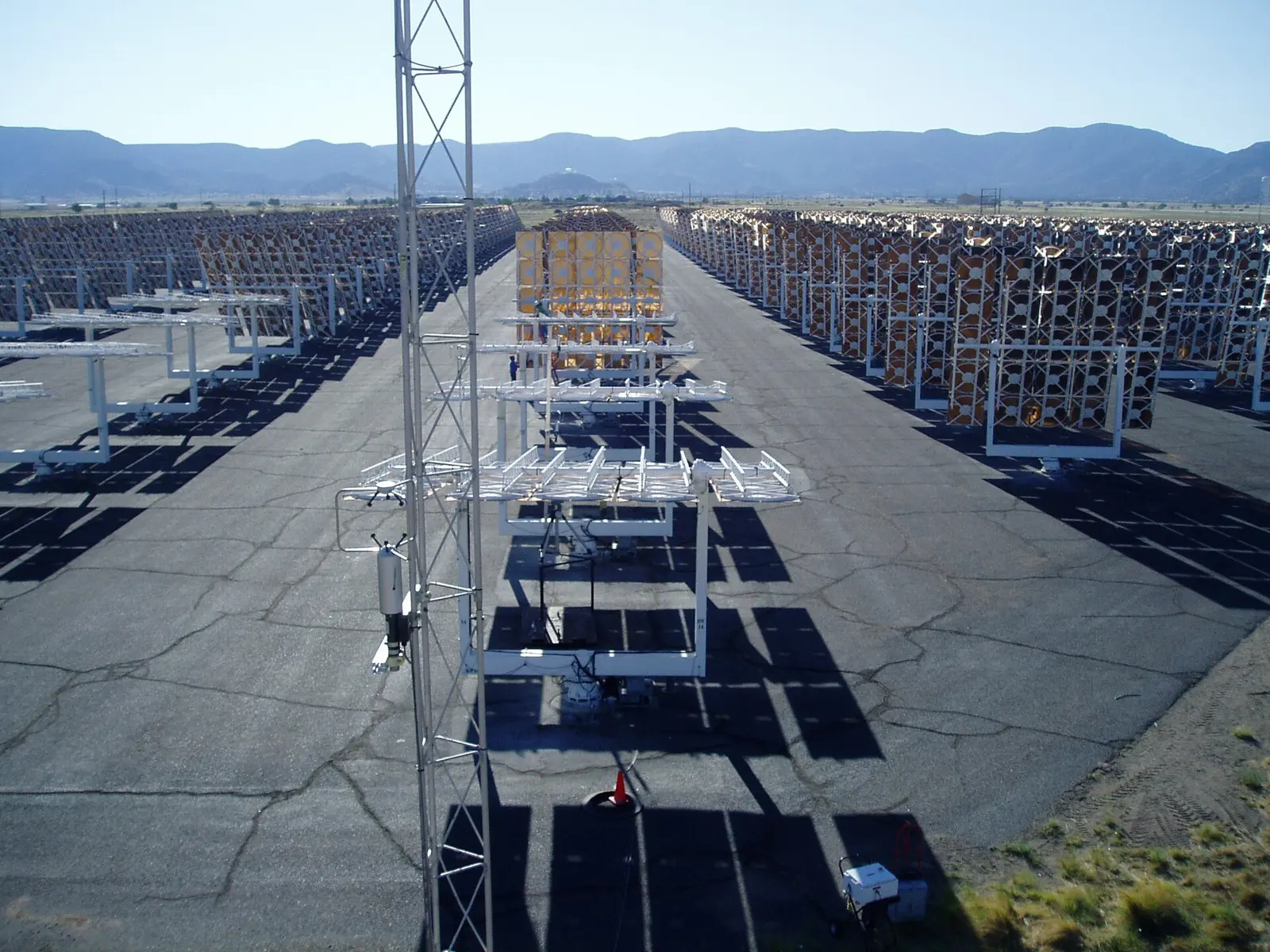
5- Mirrors (trough collectors or heliostats)
- Tracking drives and field controls
- Receiver tubes or tower receiver
- Heat-transfer fluid piping and pumps
- Cleaning vehicles
Storage and heat exchange
5- Hot and cold salt tanks
- Salt pumps and valves
- Oil-to-salt heat exchangers (trough)
- Steam generator: preheater, evaporator, superheater, reheater
- Heat tracing and insulation
Power block
5- Reheat steam turbine (typically 50–150 MW)
- Generator, excitation and step-up transformer
- Air-cooled or wet cooling system
- Feedwater, condensate and water treatment
- Distributed control system
Section 06
Hybrid CSP + PV and Solar Process Heat
Pairing CSP with PV combines the cheapest daytime solar energy with low-cost thermal storage for the evening and night; the same concentrating collectors can also serve industry directly as heat.
01
Round-the-clockCSP + PV hybrid
PV supplies the grid by day while the CSP field charges the salt tanks; the steam turbine runs from evening through the night.
02
Electric heatersPV-charged thermal storage
Surplus PV electricity heats salt through electric heaters, adding to the stored energy at low cost.
03
Firm supplyCSP with fuel backup
A gas or biomass heater keeps the turbine available on cloudy days where firm capacity is contracted.
04
IndustrySolar process heat
Trough or Fresnel collectors supply steam or hot oil at 100–400 °C to dairies, textiles, food, chemicals and pharma.
05
WaterSolar desalination and cooling
Concentrated heat drives thermal desalination or absorption chillers.
Hybrid sizing (PV MW, CSP MW, storage hours, solar multiple) is found by modelling hourly demand and tariff against the site's DNI and GHI.
Section 07
Grid Connection and Dispatch
Utility CSP plants connect at 132, 220 or 400 kV and are scheduled with the load despatch centre like a thermal unit.
- Connectivity and grid access application
- Switchyard, step-up transformer and line bay
- Day-ahead and intraday schedules from storage state
- Inertia, reactive power and frequency response from the synchronous generator
- Peak and night-time supply contracts
- Auxiliary power import during long cloudy spells
Section 08
Project Development and Approvals
A CSP project needs the same land, water and grid permissions as a thermal plant of similar size, plus long-term solar measurements to satisfy lenders.
- 1Site screening on satellite DNI and land data
- 2Ground DNI station installed (at least 12 months of data)
- 3Pre-feasibility and technology selection
- 4Land purchase or lease and land-use change
- 5Water allocation for cleaning and cooling
- 6Environmental and social assessment as required by state and lenders
- 7Grid connectivity and power purchase agreement
- 8Detailed project report and owner's engineer review
- 9Financial close and EPC award
India built its first commercial CSP plants under the National Solar Mission; lessons on DNI data quality, dust and component supply shape how new projects are assessed today.
Section 09
Turnkey EPC Delivery
CSP is a large construction project closer to a thermal power station than to a PV farm. BARREL can coordinate a single EPC contract or separate solar field, storage and power block packages.
Solar field
4- Land grading and foundations
- Collector or heliostat assembly hall
- Mirror installation and alignment
- Receiver and HTF piping
Storage and tower
4- Tank foundations with cooling
- Tank erection and insulation
- Tower construction (concrete or steel)
- Salt melting and first fill
Power block and BoP
4- Turbine-generator and steam generator
- Cooling system
- Electrical, switchyard and line
- DCS, commissioning and performance test
9.1Typical schedule (100 MW with storage)
- DNI measurement 12 mo
- Development & approvals 12–18 mo
- Construction 24–36 mo
- Commissioning & ramp-up 6–12 mo
Section 10
Operation and Maintenance
CSP plants need a resident operations team; mirror cleanliness and salt system reliability have the largest effect on annual output.
- Mirror cleaning by water-saving brush or spray vehicles
- Tracking calibration and drive maintenance
- Receiver tube and tower receiver inspection
- Salt chemistry and freeze-protection checks
- Heat tracing and insulation repair
- Steam turbine and generator outages in low-DNI seasons
- Daily dispatch planning from storage and forecast
- Spares for mirrors, receivers, pumps and valves
- Performance monitoring against the energy model
Section 11
Finance and Commercial Models
CSP costs more per MW than PV, but the value lies in firm, dispatchable energy, especially at evening peaks; it is usually procured through long-term PPAs that recognise this.
| Item | Typical range (international, indicative) |
|---|---|
| Capital cost | Several times a PV plant per MW, depending on storage hours |
| Capacity factor | 40–60 % or more with long storage at very good DNI sites |
| Construction period | 2–3 years |
| Revenue options | Long-term PPA, peak or round-the-clock tenders, process heat supply contracts |
| Debt tenor | 15–20 years with export credit or development finance support |
Figures are indicative for early screening only; each project needs its own DNI study, cost estimate and financial model.
Section 12
BARREL Services for Concentrated Solar Power
BARREL coordinates DNI specialists, technology providers, thermal engineers, contractors and financiers to take CSP and solar heat projects from idea to operation.
- Site screening and DNI measurement
- Technology selection and hybrid sizing
- Pre-feasibility and DPR
- Approvals and land support
- Owner's engineer and lender's engineer
- Solar field and storage sourcing
- Turnkey EPC / EPCM
- Grid connectivity and PPA support
- Solar process heat for industry
- Project finance facilitation
- O&M and performance monitoring
- Acquisition due diligence
Project desk
Build your CSP or solar heat project with BARREL
Solar energy on demand, day and night.
Planning a CSP plant, a CSP + PV hybrid, solar steam for a factory or thermal storage for a power plant — tell us about the site and the demand, and we will respond with the next steps.
Project categories
- Solar tower
- Parabolic trough
- Linear Fresnel
- CSP + PV hybrid
- Solar process heat
- Thermal storage