
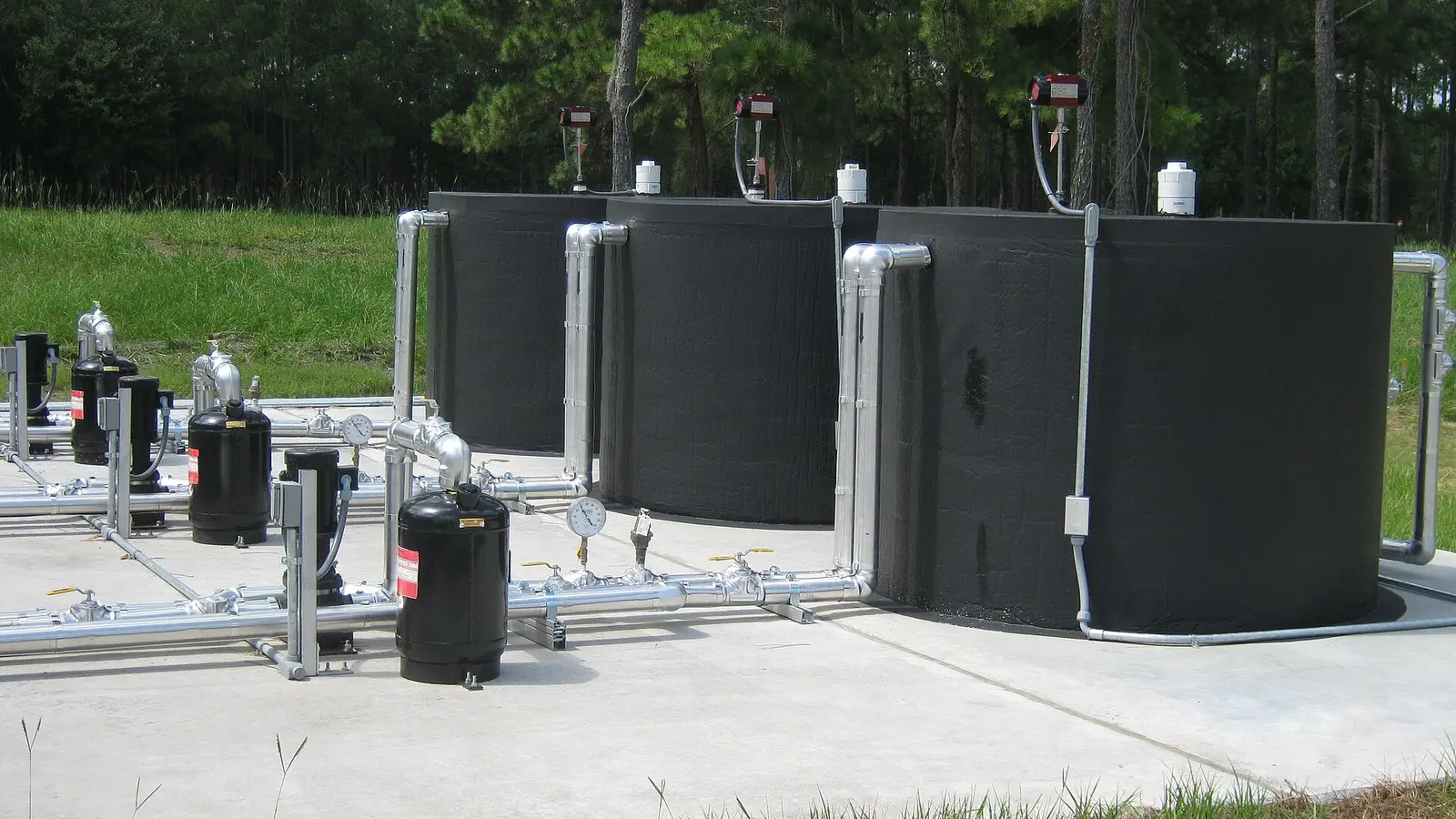
Thermal energy storage (TES) captures heat or cold when it is cheap or available — sunlight, off-peak or surplus renewable electricity, process waste heat — and supplies it later as hot water, steam, hot air, chilled water or, through a power cycle, electricity.
Unlike electrochemical batteries, TES stores energy in water, salts, oils, rock, sand, concrete, ceramics, phase-change materials or reversible chemical reactions. It is usually far cheaper per kWh stored, scales to very large sizes and can last for decades, but it delivers heat first: converting back to electricity adds a power-cycle loss.
Key facts
- Principles
- Sensible, latent, thermochemical
- Duration
- Minutes to seasons
- Temperature
- Below 0 °C to above 1,000 °C
- Outputs
- Hot water, steam, hot air, chilled water, power
Why TES is used8
- Separates the time energy is generated from the time it is needed
- Improves renewable energy utilisation and absorbs surplus electricity
- Recovers and re-uses industrial waste heat
- Supports industrial decarbonisation and process-heat electrification
- Adds flexibility to power systems and heat networks
- Supplies district heating, cooling and process industries
- Enables dispatchable output from concentrated solar power
- Stores heat for hours, days or seasons depending on technology
How the energy flows5
- Energy & heat sources — Solar thermal, surplus renewable electricity, waste heat, industrial heat, geothermal
- Conversion & charging — Electric heaters, heat pumps, heat exchangers, solar receivers
- Thermal energy storage — Hot water, molten salts, solid media, phase-change and thermochemical materials
- Direct heat supply — Industrial processes, district heating, steam, hot water
- Power generation — Steam turbine, Organic Rankine Cycle and other power cycles
Main design questions6
- What temperature does the user need, and how steady?
- How many hours or days between charge and use?
- What is the charging source and its price profile?
- How much space, weight and civil work is acceptable?
- Is the output heat, cold or electricity?
- Which safety and pressure rules apply?
Technology overview
| Technology | Storage principle | Typical application |
|---|---|---|
| Hot water | Sensible | Buildings, district heating |
| Molten salt | Sensible | CSP and power generation |
| Thermal oil | Sensible | Industrial heat |
| Rock / sand | Sensible | High-temperature storage |
| Concrete / ceramic | Sensible | Industrial heat and power |
| PCM | Latent | Compact heat storage |
| Salt hydrates | Latent | Low/medium-temperature storage |
| Thermochemical | Chemical / sorption | Long-duration storage |
Related calculators
Calculators are available to staff / admin only.
Related topics
- Sensible HeatThe simplest and most deployed principle: energy is stored by heating water, salts, oils or solids without a change of state.
- Latent HeatPhase-change materials absorb and release heat as they melt and freeze — compact storage at a nearly constant temperature.
- ThermochemicalHeat drives a reversible reaction or sorption process; energy stays locked in the separated products until they recombine.
- Thermal BatteryIntegrated systems that turn electricity — often cheap renewable power — into stored high-temperature heat for steam, hot air or power.
- Engineering & DesignFeasibility, basic (FEED) and detailed engineering plus system integration for every type of heat storage plant.
Project & partnership desk
Planning Thermal Energy Storage?
Tell us your heat demand, site and timeline — BARREL engineers, suppliers and partners will help you scope it.